
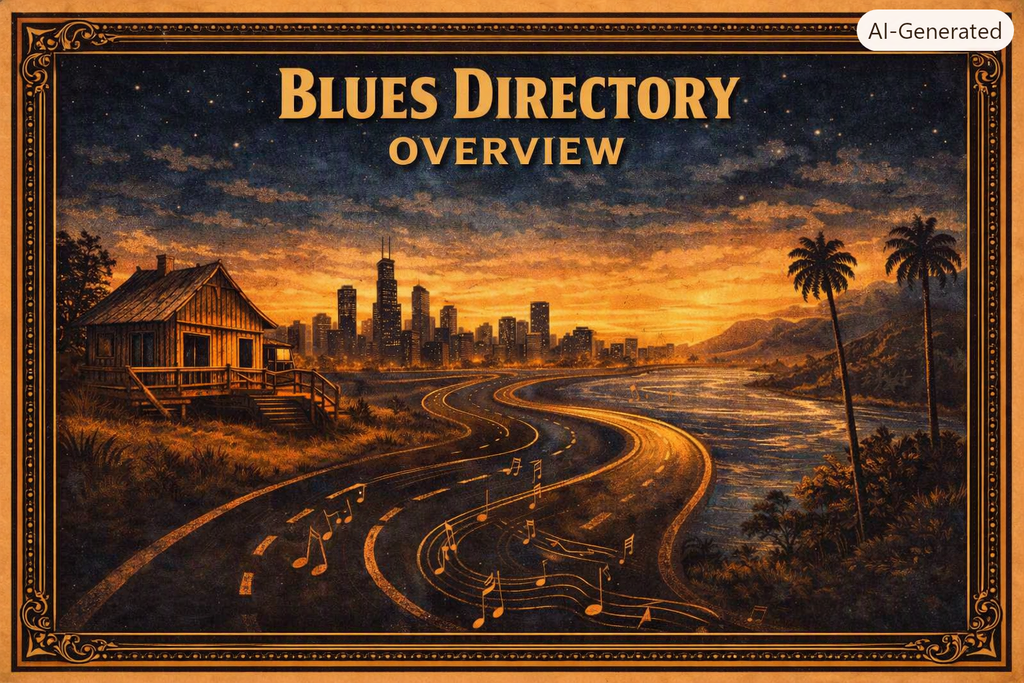
Blues Directory Overview
The blues emerged among freed African Americans during the Reconstruction era, blending African traditions with European folk influences. Defined by the 12-bar structure and blue notes, the genre evolved from vocal field hollers into a sophisticated musical form featuring distinct guitar techniques and emotional expression. As musicians migrated to urban centers, the acoustic Delta style transitioned into an amplified sound that influenced rock and roll. This living tradition remains the foundational element for numerous modern genres, representing a historical record of resilience and creative innovation within global popular music.
Core Origins
- Post‑Emancipation creation — Blues is not slave music; it emerged among freed African Americans in the late 1860s during Reconstruction, shaped by sharecropping, segregation, and racial violence.
- African musical foundations — Call‑and‑response, field hollers, work songs, spirituals, melisma, blue notes, and rhythmic chants formed the raw material.
- European folk influence — 19th‑century American folk and popular song blended with African traditions to create early blues forms.
Musical Characteristics
- Primarily a vocal form expressing emotion rather than narrative storytelling.
- 12‑bar blues becomes the dominant structure in the early 20th century.
- AAB lyrical pattern and blue notes (flattened 3rd, 5th, 7th) define the sound.
- Signature techniques: string bending, slides, vibrato, improvisation.
- Instrumentation evolution: banjo → acoustic guitar → electric guitar; harmonica, piano, mandolin added over time.
Delta Blues: The First Major Style
- Emerges in the Mississippi Delta, one of the harshest agricultural regions in the South.
- Defined by raw vocals, bottleneck/slide guitar, and improvisation.
- Played in juke joints, crucial early venues for blues culture.
- Key figures: Charley Patton, Son House, Robert Johnson, Memphis Minnie.
The Great Migration & Urban Blues
- Millions of African Americans move north (1910–1970), transforming the music’s sound and audience.
- Chicago Blues electrifies the genre: amplified guitars, full bands, driving rhythm.
- Major artists: Muddy Waters, Howlin’ Wolf, Little Walter.
- This electrification directly seeds rhythm & blues and rock and roll.
Key Historical Milestones
- 1912 — W.C. Handy publishes Memphis Blues, bringing blues into mainstream sheet music.
- 1920 — Mamie Smith’s Crazy Blues sells over a million copies; marks the commercial breakthrough of recorded blues.
- 1936–37 — Robert Johnson records foundational Delta blues sides.
- 1940s–50s — Chess Records era; Chicago Blues becomes dominant.
- 1960s — British blues revival (Rolling Stones, Yardbirds, Clapton) reintroduces blues to global audiences.
- 2003 — U.S. Congress declares the “Year of the Blues.”
- 2015 — Blues Hall of Fame opens in Memphis.
Influence on Modern Music
- Blues is the foundation of jazz, R&B, soul, rock and roll, country, and later hip‑hop.
- The pentatonic scale, 12‑bar progression, and guitar techniques used across rock and pop come directly from blues traditions.
- Artists from Elvis Presley to Jimi Hendrix, Eric Clapton, Stevie Ray Vaughan, and Gary Clark Jr. trace their musical language to blues.
Why the Blues Still Matters
- It is a living tradition, not a relic — continually evolving through modern artists.
- Represents a cultural record of African American resilience, creativity, and lived experience.
- Its musical structures remain embedded in nearly every genre of Western popular music.