
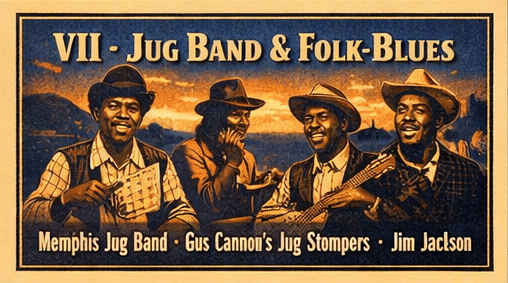
Blues Directory: Jug Bands & Folk Blues
Part rural folk tradition, part street-corner performance art, jug band music and folk-blues were community sounds — mixing blues, ragtime, hokum, and found-instrument ingenuity into something gloriously eclectic and irresistibly fun. These artists remind us that before the blues was an art form studied in universities, it was simply music people made together for the joy of it.
Memphis Jug Band (active 1927 – 1934)
Led by guitarist and vocalist Will Shade, the Memphis Jug Band was the most popular and prolific jug band of the recording era, blending blues, ragtime, pop songs, and sheer entertainment into a repertoire that delighted both Black and white audiences across the South. Their recording sessions for Victor captured a rotating cast of Memphis Street musicians at their most inventive — washboards, jugs, kazoos, harmonicas, and guitars all deployed in the service of irresistibly catchy music. Songs like “Stealin’,” “K.C. Moan,” and “Cocaine Habit Blues” became staples of the folk revival, covered by the Grateful Dead, Maria Muldaur, and others. The Jug Band’s recordings remain some of the most infectiously joyful documents in American music history.
Gus Cannon’s Jug Stompers (active 1927 – 1930)
Banjo player and vocalist Gus Cannon led one of the great jug bands of the 1920s, the Jug Stompers, whose recordings for Victor featured the extraordinary harmonica playing of Noah Lewis alongside Cannon’s rhythmically driving banjo and jug. Cannon was born in Red Banks, Mississippi in 1883 and was already a veteran street and medicine show performer by the time he made his first records. His “Walk Right In,” recorded in 1929, was revived by the Rooftop Singers in 1963 and became a number one pop hit, earning the then-80-year-old Cannon long overdue royalties. Cannon himself lived to 96 and remained a beloved figure in Memphis blues until his death in 1979.
Mississippi John Hurt (see also Section IV: Piedmont Blues)
While Hurt appears in the Piedmont section for his guitar style, his repertoire and spirit were equally rooted in the folk-blues and jug band traditions — his warm, storytelling approach to songs like “Stack O’ Lee Blues” and “Candy Man” placing him squarely in the community music tradition where genres blurred freely.
Jim Jackson (c. 1884 – 1937)
A medicine show veteran and Memphis street performer, Jim Jackson was one of the most popular entertainers of the late 1920s race record era, his “Jim Jackson’s Kansas City Blues” — released in 1927 — selling over 100,000 copies and making him a genuine commercial star. Jackson’s style was rooted in the hokum and minstrel traditions, and he performed with a loose, crowd-pleasing ease that translated brilliantly to record. He was a fixture of the Memphis music scene alongside Will Shade and Gus Cannon, and his recordings provide an essential document of the transitional moment when Southern folk entertainment became commercial blues. Though largely forgotten today, his influence on the lighter side of blues tradition — the storytelling, showmanship, and humor — was substantial.
Key Points
- Jug band music combines blues, ragtime, and folk traditions, creating a fun community sound.
- The Memphis Jug Band, led by Will Shade, was pivotal in popularizing jug band music through catchy recordings in the 1920s.
- Gus Cannon’s Jug Stompers featured a unique blend of banjo and harmonica, with Cannon gaining fame from his hit ‘Walk Right In.’
- Mississippi John Hurt’s music reflects jug band roots and storytelling, blurring genre lines.
- Jim Jackson’s performances captured the essence of humor and showmanship in early blues, making him a notable figure in the 1920s.