
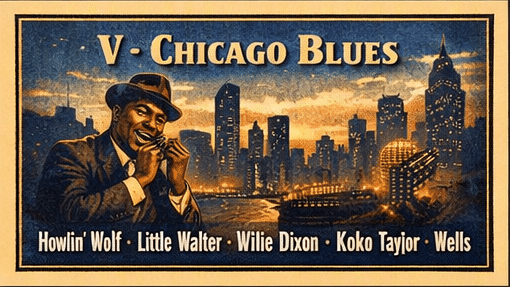
Chicago Blues, Boogie-Woogie & Piano Blues, Jug Bands & Folk-Blues

Chicago Blues, Boogie-Woogie & Piano Blues, Jug Bands & Folk-Blues

Electric Chicago blues emerged as Southern migrants brought traditional music north, integrating amplification and innovative techniques. Key figures developed a powerful urban sound that became a primary foundation for rock and roll. This era transformed folk instruments and introduced influential songwriting and vocal styles to the world.

Piano blues and community jug bands also shaped American music through rhythmic innovation and diverse instrumentation. These genres represent a living language of resilience and artistry that continues to evolve. Local organizations document these foundational artists to preserve their history and celebrate their significant and ongoing cultural impact.

When Southern migrants brought their music north to Chicago in the 1930s and 1940s, they plugged in, turned up, and created one of the most electrifying urban sounds in American history. The electric Chicago Blues that emerged from Chess Records, the South Side clubs, and the Maxwell Street market would fuel rock and roll around the entire world.

Howlin’ Wolf (Chester Burnett) (1910 – 1976)

With one of the most ferocious voices in the history of recorded music — a deep, howling baritone that Sam Phillips of Sun Records described as “where the soul of a man never dies” — Howlin’ Wolf was the supreme embodiment of the Chicago electric blues. Born in White Station, Mississippi, he absorbed the styles of Charley Patton and Son House before heading north to record for Chess Records, where his work with guitarist Hubert Sumlin produced some of the most electrifying blues records ever made. His recordings of “Smokestack Lightnin’,” “Spoonful,” “Back Door Man,” and “Killing Floor” — many written by Willie Dixon — became blueprints for British Invasion bands including the Rolling Stones and the Yardbirds. Wolf’s physicality on stage — he would crawl, howl, and writhe — was the prototype for rock and roll performance.

Little Walter (Marion Walter Jacobs) (1930 – 1968)

The musician who transformed the harmonica from a folk instrument into an electrifying lead voice, Little Walter Jacobs arrived in Chicago as a teenager from Louisiana and quickly became the most innovative harp player the blues world had ever seen. By cupping a small amplified microphone in his hands along with his harmonica, he created a full, saxophone-like tone that redefined what the instrument could do, and his work on Muddy Waters’s early Chess sides set a new standard for blues accompaniment. His own recordings as a bandleader — including “Juke,” which reached Number One on the R&B charts in 1952, and “My Babe” — remain benchmarks of Chicago blues. Walter’s troubled life ended at 37, but his innovations still resonate in every amplified harmonica player working today.
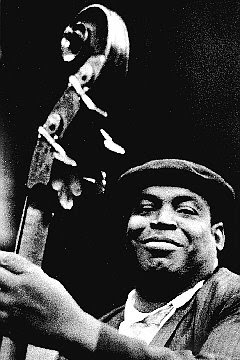
Willie Dixon (1915 – 1992)

Willie Dixon (1915 – 1992)

The architect of the Chess Records sound and one of the most important songwriters in American music history, Willie Dixon composed, arranged, produced, and performed the songs that defined Chicago blues and, by extension, rock and roll. Born in Vicksburg, Mississippi, he was a gifted upright bassist and vocalist, but his greatest gift was the song — he wrote “Hoochie Coochie Man,” “Wang Dang Doodle,” “Little Red Rooster,” “Spoonful,” and dozens of others that became standards for Muddy Waters, Howlin’ Wolf, Koko Taylor, and Sonny Boy Williamson. British bands — the Rolling Stones, Led Zeppelin, Cream — covered his songs extensively, and Dixon spent much of his later years in litigation to reclaim credit and royalties. His legacy is foundational to any understanding of how the blues shaped popular music.

Koko Taylor (Cora Walton) (1928 – 2009)

The undisputed “Queen of the Blues,” Koko Taylor was a ferocious vocalist from Shelby County, Tennessee who moved to Chicago in the 1950s and became one of the most powerful presences in the history of the genre. Discovered by Willie Dixon, she recorded his composition “Wang Dang Doodle” in 1965 — it became a massive R&B hit and launched one of the most enduring careers in Chicago blues. Taylor’s voice was a force of nature — rough, powerful, and commanding — and she used it to speak for working-class Black women with an authority no other artist could match. She won multiple Grammy Awards, was inducted into the Blues Hall of Fame, and performed actively until shortly before her death at age 80.

Junior Wells (Amos Blakemore) (1934 – 1998)

A South Memphis native who became a Chicago blues titan, Junior Wells was a harmonica virtuoso and showman who joined Muddy Waters’s band as a teenager — replacing Little Walter — and went on to forge one of the great partnerships in blues history with guitarist Buddy Guy. His 1965 album Hoodoo Man Blues, recorded for Delmark Records, is widely regarded as one of the definitive Chicago blues recordings of the era, capturing his growling harmonica and streetwise vocals at their peak. Wells and Guy played together for decades, their chemistry — sly, humorous, deeply swinging — making them a live act without equal. Wells brought an infectious, crowd-pleasing energy to the Chicago blues stage that made him one of its most beloved ambassadors.

Boogie-Woogie & Piano Blues

Long before rock and roll existed, boogie-woogie pianists were shaking dance floors with rolling left-hand bass lines and syncopated right-hand figures that made entire rooms move. These keyboard masters were some of the most joyfully irresistible performers in American music — and their influence on every piano-driven popular style that followed cannot be overstated.

Pine Top Smith (Clarence Smith) (1904 – 1929)

The man credited with coining the term “boogie-woogie” and recording the first boogie-woogie piano piece, Pine Top Smith was a Birmingham, Alabama native who made his mark in the turbulent world of rent parties and house dances in Chicago’s South Side. His 1928 recording “Pine Top’s Boogie Woogie” for Vocalion Records was a sensation — a rollicking, instructional party record in which Smith called out dance moves over his driving piano — and it launched a craze that would explode into mainstream popularity a decade later. Tragically, Smith was shot and killed at age 24 in a dance hall altercation, just as his star was rising. His influence on every boogie-woogie pianist who followed — and on rock and roll piano itself — is incalculable.

Meade Lux Lewis (1905 – 1964)

A Chicago native who became one of the three great masters of boogie-woogie alongside Albert Ammons and Pete Johnson, Meade “Lux” Lewis was a supremely gifted pianist whose recording of “Honky Tonk Train Blues” — made in 1927 — was rediscovered in 1935 and triggered a nationwide boogie-woogie revival. His performances at Carnegie Hall’s famous 1938 “From Spirituals to Swing” concert introduced boogie-woogie to mainstream American audiences and launched a craze that would dominate popular music well into the 1940s. Lewis possessed an almost classical technique married to deep blues feeling, and his recordings remain some of the most joyously kinetic piano music ever captured. He continued performing until his death in a California automobile accident.

Albert Ammons (1907 – 1949)

One of the triumvirate of boogie-woogie masters who ignited a national craze after their 1938 Carnegie Hall performances, Albert Ammons was a Chicago pianist of irresistible swing and technical brilliance, his rolling bass lines and right-hand figures creating a percussive, locomotive energy that made dancing virtually compulsory. Born on the South Side, Ammons played Chicago clubs and rent parties before his Carnegie Hall debut propelled him to national fame, leading to residencies at New York’s Café Society — the first racially integrated nightclub in Manhattan. His recordings of “Boogie Woogie Stomp” and “Bass Goin’ Crazy” are foundational documents of the style. His son, Gene Ammons, became a celebrated jazz saxophonist, continuing the family’s musical legacy.

Memphis Slim (John Chatman) (1915 – 1988)

Born in Memphis and polished in Chicago, Memphis Slim was a pianist of uncommon elegance — bringing sophistication, wit, and blues authenticity to his recordings in equal measure and becoming one of the most beloved blues performers of the postwar era. He worked with Big Bill Broonzy and recorded prolifically under his own name from the early 1940s onward, his “Every Day I Have the Blues” becoming one of the most recorded songs in blues history. Unlike many of his peers, Slim found a particularly enthusiastic reception in Europe during the 1960s folk-blues boom and ultimately relocated to Paris, where he was celebrated as an elder statesman of American music. He remained a tireless ambassador for the blues until his death, performing, recording, and educating audiences across the globe.

Jug Band & Folk-Blues

Part rural folk tradition, part street-corner performance art, jug band music and folk-blues were community sounds — mixing blues, ragtime, hokum, and found-instrument ingenuity into something gloriously eclectic and irresistibly fun. These artists remind us that before the blues was an art form studied in universities, it was simply music people made together for the joy of it.

Memphis Jug Band (active 1927 – 1934)

Led by guitarist and vocalist Will Shade, the Memphis Jug Band was the most popular and prolific jug band of the recording era, blending blues, ragtime, pop songs, and sheer entertainment into a repertoire that delighted both Black and white audiences across the South. Their recording sessions for Victor captured a rotating cast of Memphis street musicians at their most inventive — washboards, jugs, kazoos, harmonicas, and guitars all deployed in the service of irresistibly catchy music. Songs like “Stealin’,” “K.C. Moan,” and “Cocaine Habit Blues” became staples of the folk revival, covered by the Grateful Dead, Maria Muldaur, and others. The Jug Band’s recordings remain some of the most infectiously joyful documents in American music history.

Gus Cannon’s Jug Stompers (active 1927 – 1930)

Banjo player and vocalist Gus Cannon led one of the great jug bands of the 1920s, the Jug Stompers, whose recordings for Victor featured the extraordinary harmonica playing of Noah Lewis alongside Cannon’s rhythmically driving banjo and jug. Cannon was born in Red Banks, Mississippi in 1883 and was already a veteran street and medicine show performer by the time he made his first records. His “Walk Right In,” recorded in 1929, was revived by the Rooftop Singers in 1963 and became a number one pop hit, earning the then-80-year-old Cannon long overdue royalties. Cannon himself lived to 96 and remained a beloved figure in Memphis blues until his death in 1979.

Mississippi John Hurt (see also Section IV: Piedmont Blues)

While Hurt appears in the Piedmont section for his guitar style, his repertoire and spirit were equally rooted in the folk-blues and jug band traditions — his warm, storytelling approach to songs like “Stack O’ Lee Blues” and “Candy Man” placing him squarely in the community music tradition where genres blurred freely.

Jim Jackson (c. 1884 – 1937)

A medicine show veteran and Memphis street performer, Jim Jackson was one of the most popular entertainers of the late 1920s race record era, his “Jim Jackson’s Kansas City Blues” — released in 1927 — selling over 100,000 copies and making him a genuine commercial star. Jackson’s style was rooted in the hokum and minstrel traditions, and he performed with a loose, crowd-pleasing ease that translated brilliantly to record. He was a fixture of the Memphis music scene alongside Will Shade and Gus Cannon, and his recordings provide an essential document of the transitional moment when Southern folk entertainment became commercial blues. Though largely forgotten today, his influence on the lighter side of blues tradition — the storytelling, showmanship, and humor — was substantial.

The Living Legacy

The artists documented in these pages did not simply make music — they built a language. A language of feeling, of resistance, of humor in hardship, of beauty wrested from difficult circumstances. That language lives on in every blues guitarist who bends a string toward the sky, in every harmonica player who cups a microphone in their palms the way Little Walter taught the world, in every singer who digs past technique to find the truth in a song. The blues is not a relic. It is a living, breathing, evolving art form, and its roots run deeper into American culture than almost any other.

The Madison Blues Society is proud to be a steward of this history in Madison, Wisconsin — through live performances, educational programming, community events, and resources like this directory. We believe that knowing where music comes from deepens our appreciation of where it is going, and that the artists profiled here deserve to be celebrated not just by specialists but by every music lover with an open ear and a willing heart.

This directory will be expanded regularly as the Madison Blues Society continues its ongoing mission to document, celebrate, and share the full breadth of blues history. Future editions will include Texas Blues, West Coast Blues, Soul Blues, and profiles of contemporary artists carrying the tradition forward. We welcome community contributions, corrections, and additions — please contact the Society through our website or attend one of our monthly gatherings.