
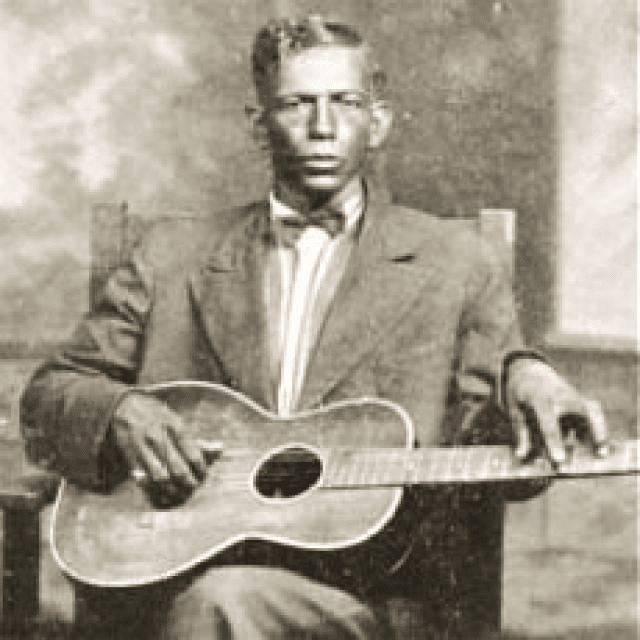
Charley Patton (b. 1891, d. 1934) remains one of the most important and influential talents in American music history. Patton is regarded as the “Father of the Delta Blues,” as he pioneered as a singer, guitarist, songwriter, and performer. His raw power, novel techniques, and creative style was foundational for blues, rock ’n’ roll, and related genres. Patton lived a short yet explosive life, with only a five-year recording career, yet he left an enduring body of work that continues to inspire generations of musicians.
Early Life
Patton was born in Hinds County, Mississippi, near Edwards or Bolton, to sharecropping parents Bill and Annie Patton. Around 1900, when he was about nine, his family moved to the Will Dockery Plantation in Sunflower County in the heart of the Mississippi Delta. This plantation became a legendary hub for early blues musicians. Despite being considered an African American, Patton had fair skin, leading to rumors that he might have had Mexican or Cherokee Indian heritage. From a young age, Patton was drawn to music and enjoyed parties, often neglecting work.
Patton learned guitar as a teenager and quickly developed a distinctive style. By his late teens, he was performing at local parties, juke joints, and plantation dances. He quickly developed a wide repertoire when he got his first guitar. By the age of 19, he had already written some of his famous compositions. He absorbed a wide range of influences, including ragtime, ballads, spirituals, and the emerging blues form. His early associates included Willie Brown, Tommy Johnson, and others who helped shape the Delta sound. Patton was a natural entertainer—small in stature (about 5’5″) but possessing a remarkably loud, gravelly voice that could carry across fields without amplification.
Performances
Patton lived as a traveling musician, roaming the Delta and throughout the southern United States. He was known for his flamboyant performances: playing guitar behind his head or back or placing it on his shoulder, dropping to his knees, using his guitar as a percussion instrument, or even swinging it low to his feet and raising it high above his head. Patton engaged his audiences with his signature moves and rich storytelling. His songs incorporated southern history, local challenges such as drought and floods, railroads and the exploits of local sheriffs. In the late 1920s, talent scout H.C. Speir heard Patton and recommended him to Paramount Records. This led to his breakthrough recording sessions.
Recordings
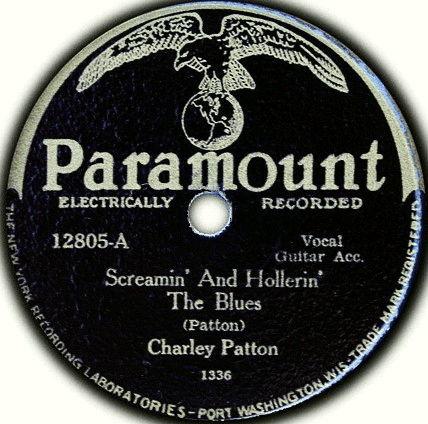
Paramount Records alone released 13 of Patton’s records, and he also recorded for other labels such as Vocalion Records, Gennett Records, and American Record Company. Patton’s recording career began on June 14, 1929, in Richmond, Indiana, for Paramount Record during which in that first session he cut 14 sides, including several masterpieces:
His early releases established Patton as a star, with soaring record sales. By the late 1920s he was the best-selling blues musician in the country. Patton again recorded at Paramount’s (1929–1930) Grafton, Wisconsin studio, producing dozens more sides, including collaborations with Willie Brown and his wife Bertha Lee:
- “A Spoonful Blues”
- “Shake It and Break It”
- “Green River Blues”
- “High Water Everywhere” (Parts 1 & 2) — A two-part epic about the 1927 Mississippi Flood.
- “Prayer of Death” (gospel sides issued under the pseudonym Elder J.J. Hadley)
Near the end of his life (1934), Patton recorded a final session in New York City for Vocalion, including tracks with Bertha Lee such as “Oh Death” and “Trouble in Mind.” He left behind 60–70 sides across Paramount and Vocalion. Although the original Paramount pressings are noisy due to poor materials, the surviving music reveals an intense, percussive, and highly rhythmic style. Patton’s guitar work featured strong rhythmic drive, intricate fingerpicking, slide techniques, and percussive elements. His voice—hoarse, powerful, and emotive—shifted between growls, shouts, and moans, often making lyrics hard to decipher but emotionally direct.
Guitar Techniques
Charley Patton’s guitar work was revolutionary and remains one of the most dynamic and influential styles in blues history. His guitar was a full percussion ensemble—powerful rhythm, melodic leads and slide work. With his showmanship, Patton gave an explosive performance. Patton’s approach bridged ragtime and folk with the raw, rhythmic intensity of Delta blues and later rock ’n’ roll.
Percussive, Multi-Layered Rhythm
Patton’s percussive playing went beyond a strum or pick—he beat the guitar like a drum. His sound incorporated slapping the top of the guitar for percussion and stomping his foot to create layered rhythms. He used his guitar as both a melodic instrument and a drum kit. His fascinating sound reflects his ability to play multiple rhythms simultaneously (bass line, strums, and treble accents). Patton’s overall work was a dense, propulsive sound that filled outdoor gathering without amplification. Patton was genius; his rhythms were complex and varied, with unexpected accents, pauses for tension, and sudden bursts of energy.
Fingerpicking, Bass Patterns, & Slide Guitar
Patton was primarily a fingerstyle player with a strong, snapping thumb. Patton’s heavy emphasis on low strings to drive the beat can be heard in “Pony Blues.” His skills also reflect strong, independent thumb work, maintaining a steady pulse while singing and adding treble fills. Patton mixed full chord strums with sparse single-note lines, creating a rich, full sound. Patton was also a master of bottleneck/slide guitar, using a brass tube or glass slide. He was able to play Spanish (bottleneck) and lap-style (knife or slide across the strings while the guitar lay flat).
Novel Techniques
Patton’s performances were legendary for flamboyant tricks that continue to influence rock guitarists. His techniques added overall rhythmic complexity while elevating his entertainment value. Patton was adept at playing behind his head or back, using his teeth, or putting the guitar between his legs. He used his guitar neck as a percussion tool while he improvised lyrics, adding spoken words and rhythmic variations.
Later Life & Death
Patton continued performing and mentoring younger musicians until his health failed. He lived life hard (heavy drinking and occasional violence) and died at 43 of heart failure (1934). Patton was initially buried in an unmarked grave; a headstone was added decades later.
Patton’s Legacy
Patton’s ability to make an acoustic guitar sound like a full band, with rhythm, percussion, melody, and bass, established a benchmark for future musicians. Modern players study his “Pony Blues” patterns, slide phrasing, and percussive attack as foundational elements. While his guitar work was raw, and “imperfect” he delivered powerful and expressive music. Patton’s work leaned hard on feel, rhythm, and emotion. His work continues as the standard more than 90 years after his death. His genius is revealed on Paramount recordings like “Pony Blues,” “Screamin’ and Hollerin’ the Blues,” or “High Water Everywhere.”
Patton’s work defined the aggressive, rhythmic Delta blues sound that fed into Chicago electric blues and rock ’n’ roll. Songs like “Pony Blues,” “Spoonful,” and “High Water Everywhere” became standards. His unique style and skills dripped with authenticity and intensity. Blues greats influenced by Patton include Son House, Willie Brown, Tommy Johnson, Howlin’ Wolf, Robert Johnson, Bukka White, Pop Staples and more.
Patton was inducted into the inaugural (1980) Blues Hall of Fame. Screamin’ and Hollerin’ the Blues: The Worlds of Charley Patton (Revenant, 7-CD box set and Document Records collections were celebrated. Today, Charley Patton is actively honored with Mississippi Blues Trail markers and continuing scholarship. Charley Patton was a cultural force; his sound roared across the Delta, echoing in each generation blues and rock. His explosive legacy is essential listening for students of roots music.