
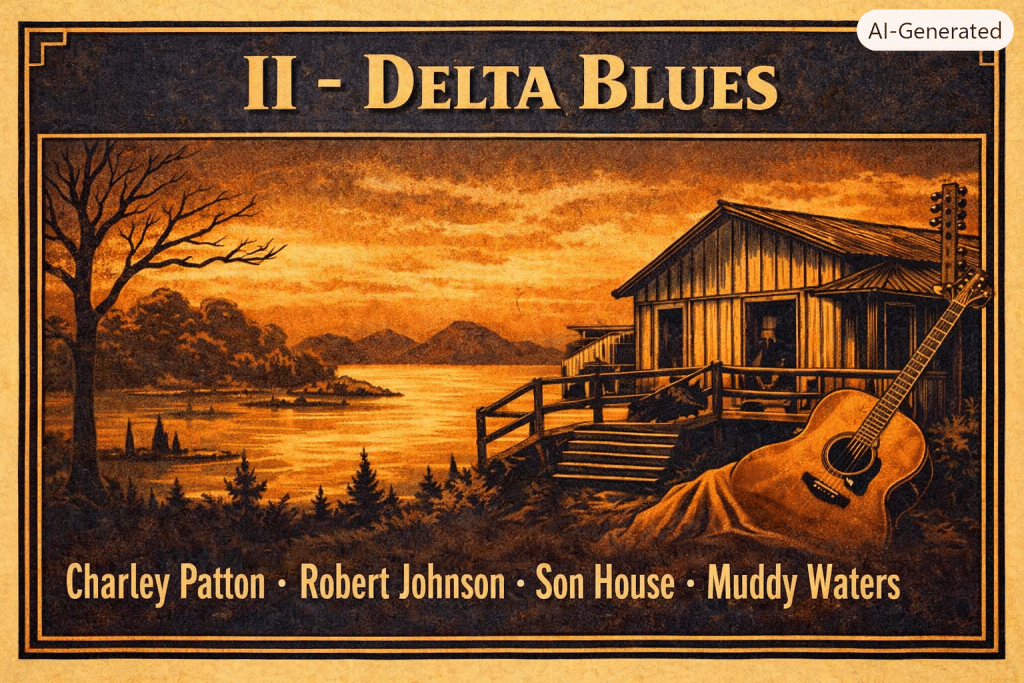
Blues Directory: Delta Blues
Born in the flatlands of Mississippi, Delta Blues is the raw, elemental heart of the entire blues tradition — deeply emotional, rhythmically powerful, and suffused with the hardship and spirituality of life in the rural South. These artists turned pain into poetry and solitude into something the whole world could hear.
Charley Patton (c. 1891 – 1934)
Widely regarded as the Father of the Delta Blues, Charley Patton was a titan of early American music whose powerful rasping voice, rhythmic guitar work, and electrifying showmanship established the template for everything that followed. Raised on the Dockery Plantation in Sunflower County, Mississippi — a legendary crossroads of early blues culture — Patton was performing for plantation dances and juke joints by his late teens, influencing virtually every Delta musician who followed him. He was an extraordinary entertainer who would twirl his guitar, rap on its body, and play it behind his back, anticipating rock and roll showmanship by decades. His recordings of “Pony Blues,” “High Water Everywhere,” and “Spoonful” remain touchstones of American music.
Robert Johnson (1911 – 1938)
No figure in blues mythology looms larger than Robert Johnson, the Mississippi Delta guitarist whose 29 recordings — made in hotel rooms in San Antonio and Dallas in 1936 and 1937 — became the most analyzed and revered documents in blues history. The legend that Johnson sold his soul to the devil at a Mississippi crossroads in exchange for his extraordinary guitar talent speaks to the almost supernatural quality of his playing and singing. His compositions — “Cross Road Blues,” “Love in Vain,” “Hellhound on My Trail,” and “Sweet Home Chicago” — became standards that the Rolling Stones, Eric Clapton, and Led Zeppelin would later carry to global audiences. Johnson died at 27, possibly poisoned, and was posthumously inducted into the Rock and Roll Hall of Fame.
Son House (1902 – 1988)
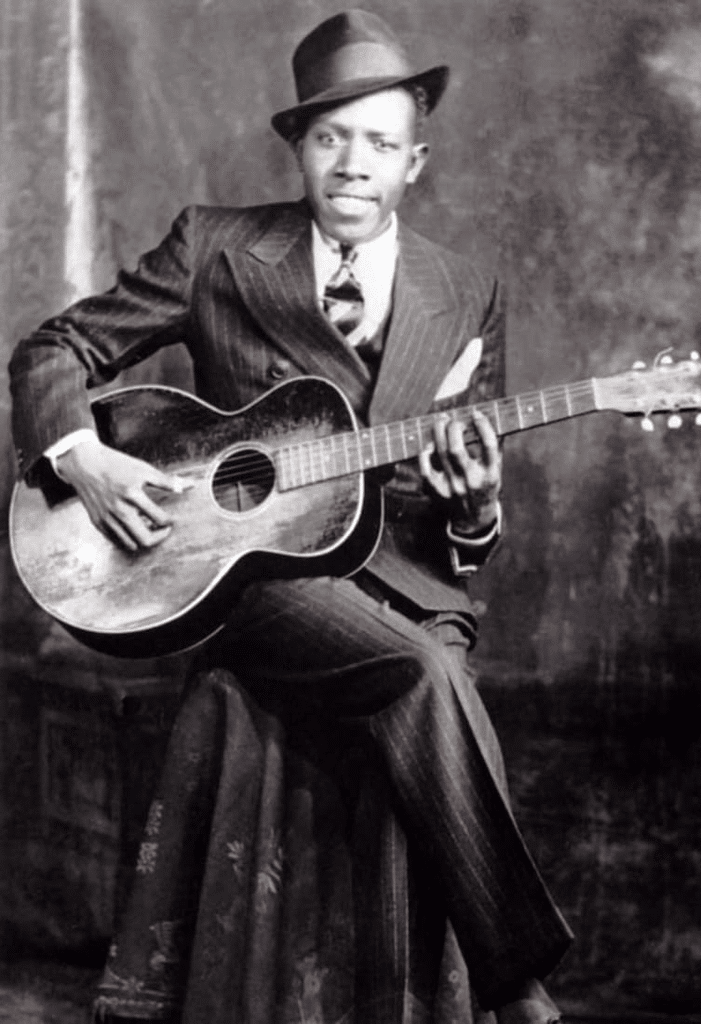
Eddie “Son” House (1902–1988) was one of the most emotionally intense Delta blues musicians. Known for his powerful vocals and slide guitar, he influenced Robert Johnson and Muddy Waters. His music blended spiritual themes with raw personal expression, making him a foundational figure in the folk‑blues revival.
A former Baptist preacher who never fully resolved the conflict between the sacred and the secular, Son House brought a ferocious emotional intensity to his Delta blues that felt like a sermon barely contained by a twelve-bar structure. He was a major influence on both Robert Johnson and Muddy Waters, who absorbed his raw slide guitar technique and his thunderous rhythmic approach in the Delta before taking it north to Chicago. House largely disappeared from music for two decades before being rediscovered during the 1960s folk revival, when his performances at coffeehouses and folk festivals introduced his genius to a new generation. His recording of “Death Letter Blues” is considered one of the most powerful performances in the entire blues canon.
Muddy Waters (McKinley Morganfield) (1913 – 1983)
The man who electrified the Delta and created modern Chicago blues, Muddy Waters was born in Rolling Fork, Mississippi, and raised on Stovall Plantation, where folklorist Alan Lomax recorded him for the Library of Congress in 1941. He moved to Chicago in 1943, plugged his slide guitar into an amplifier, and changed American music forever — recording for Chess Records a string of immortal sides including “Rollin’ Stone,” “Hoochie Coochie Man,” “Mannish Boy,” and “I’m Your Hoochie Coochie Man.” The Rolling Stones took their name from his song, and his electric band — featuring Little Walter, Jimmy Rogers, and Otis Spann — defined the Chicago blues sound. Without Muddy Waters, there is no rock and roll as we know it.
Skip James (1902 – 1969)
One of the most hauntingly original voices in all of blues, Skip James was a Mississippi-born pianist and guitarist whose eerily minor-keyed compositions and high, keening falsetto placed him in a category entirely his own. His 1931 Paramount recordings — particularly “Devil Got My Woman,” “I’m So Glad,” and “Hard Time Killin’ Floor Blues” — were so stark and unsettling that they sold poorly in their time but were revered by later generations as masterworks. Like Son House, James vanished from music for decades before being rediscovered at the 1964 Newport Folk Festival, his performances leaving audiences stunned. Cream’s recording of his “I’m So Glad” introduced him to a rock audience and provided him modest royalty income in his final years.
About the Delta Blues
Delta blues is a raw, emotive style of American blues music originating in the Mississippi Delta, characterized by solo acoustic guitar, slide techniques, soulful vocals, and lyrics reflecting hardship and resilience. Delta blues emerged in the Mississippi Delta region in the late 19th and early 20th centuries, rooted in African American traditions such as work songs, field hollers, spirituals, and rhythmic chants from cotton fields and levee camps, blended with European folk influences.
The music developed amid post-Civil War socio-economic challenges, including poverty, sharecropping, and racial oppression, which inspired lyrics reflecting the struggles of African American communities. Early performances often took place in juke joints, street corners, and informal gatherings.
Delta blues is typically performed solo or in sparse duos, with the acoustic guitar as the central instrument. A hallmark of the style is the slide guitar technique, using objects like glass bottlenecks, metal slides, or knives to create wailing, vocal-like tones that mimic human cries. Fingerpicking, percussive slaps on the guitar body, and occasional harmonica accompaniment add rhythmic and melodic depth. The music often follows an AAB lyrical structure, incorporates pentatonic scales, blue notes, and polyrhythms, and emphasizes improvisation and emotional intensity.
Vocals in Delta blues range from introspective and soulful to passionate and fiery, conveying personal hardship, love, longing, and resilience. Lyrics frequently explore themes of failed romance, life on the road, labor struggles, and existential reflections, often using double entendres and storytelling techniques. The emotional delivery is central, with the guitar and voice closely intertwined in a call-and-response or improvisational manner.
Pioneering figures include Charley Patton, often called the “Father of the Delta Blues,” Son House, and Robert Johnson, whose guitar work and haunting vocals set benchmarks for the genre. As musicians migrated north during the Great Migration, Delta blues influenced Chicago blues, electric blues, rock, and jazz, shaping modern American music.
Summary Description
To describe Delta blues succinctly: it is a soulful, improvisational, and rhythmically expressive style of blues that reflects the cultural and social realities of the Mississippi Delta, featuring solo acoustic guitar, slide techniques, emotive vocals, and lyrics rooted in hardship and resilience. Its raw intensity and distinctive sound make it a foundational element of American music history.