
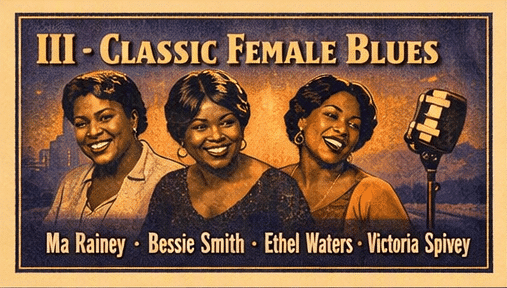
Blues Directory: Women in the Blues
Before the Delta bluesmen were recorded, Black women ruled the blues — commanding stages, headlining theater circuits, and making the genre’s first commercial recordings. These artists were the original stars of the blues world, and their artistry, business acumen, and cultural courage helped shape American entertainment for generations.
Summary
- Black women dominated the blues genre before and during the early recording era, significantly shaping American entertainment.
- Ma Rainey, known as the ‘Mother of the Blues,’ influenced many female artists and recorded her first songs in 1923.
- Bessie Smith, the ‘Empress of the Blues,’ was the most successful blues singer of the 1920s, merging blues with jazz elements.
- Ethel Waters crossed genres from blues to mainstream, becoming an accomplished actress and earning an Academy Award nomination.
- Victoria Spivey recorded her first hit at 21 and later founded Spivey Records, promoting blues history and new talents.
Ma Rainey (Gertrude Pridgett) (1886 – 1939)
Called the “Mother of the Blues,” Gertrude “Ma” Rainey was the first great professional blues singer and the woman who gave shape and form to the genre before it was ever committed to vinyl. Born in Columbus, Georgia, she was performing in traveling tent shows by age 14, and by the time she made her first recordings for Paramount in 1923, she was already a seasoned, commanding artist with a huge following across the South. Her recordings — gruff, earthy, and utterly assured — cover everything from traditional folk blues to explicitly queer themes, making her an important cultural figure far ahead of her time. She was a mentor to Bessie Smith and influenced every female blues singer who came after her.
Bessie Smith (1894 – 1937)
The “Empress of the Blues,” Bessie Smith was the greatest and most commercially successful blues singer of the 1920s, a towering artist whose rich contralto voice and dramatic delivery made her the biggest African American recording star of her era. Born in Chattanooga, Tennessee, she joined Ma Rainey’s touring company as a teenager and learned from the master before forging her own path. Her Columbia Records sessions — including her recording of W.C. Handy’s “St. Louis Blues” with Louis Armstrong — are among the finest American recordings ever made, combining blues feeling with jazz sophistication. Smith died in a car accident in Mississippi in 1937; a headstone was placed on her grave decades later, purchased jointly by singer Juanita Green and rock star Janis Joplin.
Ethel Waters (1896 – 1977)
A transitional figure who bridged blues, jazz, and Broadway, Ethel Waters was one of the most versatile and accomplished entertainers of the twentieth century, beginning her career as a blues singer and evolving into a celebrated actress and gospel performer. She recorded with some of the greatest jazz musicians of the era — Fletcher Henderson, Duke Ellington, and Benny Goodman — and her recordings of “Stormy Weather” and “Am I Blue?” remain jazz-blues classics. Waters was among the first African American performers to cross over to mainstream white audiences, appearing on Broadway and in Hollywood films, and her dignified presence helped pave the way for later generations of Black artists. She was nominated for an Academy Award for her performance in Pinky (1949).
Victoria Spivey (1906 – 1976)
A blues singer, songwriter, pianist, and entrepreneur from Houston, Texas, Victoria Spivey had her first recording hit at just 21 years old with “Black Snake Blues,” and went on to record prolifically for OKeh, Vocalion, and other labels throughout the 1920s and 1930s. Known for her dark, witty, and often frankly ribald lyric sensibility, she brought a bluesy sophistication to her recordings that earned her a devoted following among both Black and white audiences. Later in life, she founded Spivey Records, one of the first artist-owned blues labels, and used it to record surviving blues legends and discover new talent — her artists included a young Bob Dylan, who played harmonica on several sessions. Spivey remained active as a performer and advocate for blues history until her death.