
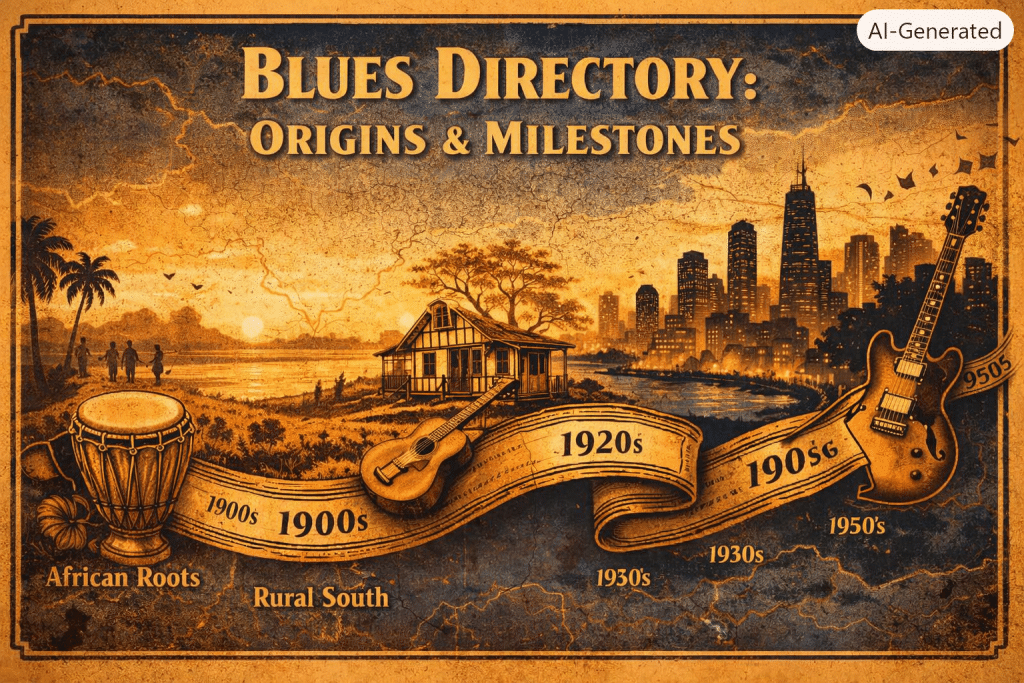
Blues Directory: Origins & Milestones
The blues emerged among freed African Americans during Reconstruction, blending African traditions like field hollers with European folk influences. Defined by a 12-bar structure and emotional vocal expression, it evolved from acoustic Delta roots into an amplified urban sound that influenced modern genres like rock and R&B. This genre serves as a historical record of resilience and innovation. From early milestones to the electric era at Chess Records, the blues remains a foundational element of global popular music. Its structures and techniques continue to shape contemporary artistic expression and many modern musical styles.
Core Origins
- Post‑Emancipation creation — Blues is not slave music; it emerged among freed African Americans in the late 1860s during Reconstruction, shaped by sharecropping, segregation, and racial violence. The blues emerged in the decades following Emancipation, created by African Americans navigating the harsh realities of Reconstruction. It was not slave music, but the artistic expression of a newly freed people confronting sharecropping, segregation, racial violence, and economic exploitation. In this environment, the blues became a way to articulate personal experience — sorrow, humor, resilience, longing — through a musical language that was intimate, flexible, and deeply human. Its earliest practitioners shaped a new art form that reflected both the trauma and the creativity of life after slavery.
- African musical foundations — Call‑and‑response, field hollers, work songs, spirituals, melisma, blue notes, and rhythmic chants formed the raw material. The roots of the blues lie in African musical traditions carried across generations. Call‑and‑response patterns, field hollers, work songs, spirituals, melismatic singing, and the use of “blue notes” all contributed to its sonic identity. These elements were not simply remnants of the past; they were living practices that evolved in Black communities. The blues absorbed these rhythms, tonalities, and vocal techniques, transforming them into a distinctly American form while preserving the emotional depth and communal spirit of African musical heritage.
- European folk influence — 19th‑century American folk and popular song blended with African traditions to create early blues forms. As African musical traditions blended with European American folk songs, ballads, and popular music of the 19th century, the blues took on new harmonic and structural characteristics. Instruments such as the guitar and banjo, along with chord progressions common in European folk music, became part of the blues vocabulary. This cultural exchange did not dilute the music’s identity — it enriched it, creating a hybrid form that could adapt, innovate, and speak to a wide range of human experiences.
Musical Characteristics
- Primarily a vocal form expressing emotion rather than narrative storytelling. At its core, the blues is a vocal tradition. Early blues singers used their voices to convey emotion more than to tell linear stories. The phrasing, tone, and delivery often carried more meaning than the literal lyrics. A single repeated line could express exhaustion, desire, defiance, or joy depending on how it was sung. This emotional immediacy remains one of the genre’s defining qualities.
- 12‑bar blues become the dominant structure in the early 20th century. By the early 20th century, the 12‑bar blues form became the genre’s most recognizable framework. Its three‑line pattern, built on I‑IV‑V chord changes, offered musicians a flexible foundation for improvisation and collaboration. This structure became so influential that it now underpins countless songs across jazz, rock, country, and pop.
- AAB lyrical pattern and blue notes (flattened 3rd, 5th, 7th) define the sound. The AAB lyrical pattern — a line repeated once, followed by a concluding line — gave singers space to emphasize emotion and develop musical ideas. Blue notes, especially the flattened 3rd, 5th, and 7th, added tension and expressiveness, creating the unmistakable “blues feel.” These tonal inflections are central to the genre’s identity and have shaped the sound of modern music.
- Signature techniques: string bending, slides, vibrato, improvisation. Blues musicians pioneered techniques that revolutionized instrumental performance: string bending, bottleneck slides, vibrato, and spontaneous improvisation. These innovations allowed players to mimic vocal inflections on their instruments, blurring the line between singing and playing. Many of these techniques later became foundational to rock and electric guitar styles.
- Instrumentation evolution: banjo → acoustic guitar → electric guitar; harmonica, piano, mandolin added over time. The blues evolved alongside its instruments. Early musicians often played banjo or homemade guitars; as access improved, acoustic guitars became standard. With urban migration and technological advances, electric guitars transformed the sound, enabling louder, more expressive performances. Harmonica, piano, mandolin, and later bass and drums expanded the blues ensemble, giving rise to full band arrangements.
Delta Blues: The First Major Style
- Emerges in the Mississippi Delta, one of the harshest agricultural regions in the South. Delta blues developed in the Mississippi Delta, a region marked by poverty, plantation agriculture, and intense racial oppression. The music reflected the environment — raw, direct, and emotionally charged. Its performers often lived itinerant lives, playing wherever they could: plantations, street corners, house parties, and juke joints.
- Defined by raw vocals, bottleneck/slide guitar, and improvisation. Delta blues is known for its gritty vocals and distinctive bottleneck slide guitar. Musicians used knives, bones, or glass slides to create haunting, vocal‑like tones. Improvisation was central; songs shifted depending on mood, audience, or circumstance. This spontaneity gave Delta blues its enduring sense of authenticity.
- Played in juke joints, crucial early venues for blues culture. Juke joints were essential to early blues culture. These informal, often raucous venues provided space for African Americans to gather, dance, socialize, and escape daily hardships. They were incubators for musical innovation, allowing performers to refine their craft and influence one another.
- Key figures: Charley Patton, Son House, Robert Johnson, Memphis Minnie. Charley Patton, Son House, Robert Johnson, and Memphis Minnie shaped the Delta tradition. Their recordings and performances laid the groundwork for nearly every blues style that followed, influencing generations of musicians worldwide.
The Great Migration & Urban Blues
- Transformation through migration: millions of African Americans move north (1910–1970), transforming the music’s sound and audience. Between 1910 and 1970, millions of African Americans moved from the rural South to northern cities such as Chicago, Detroit, and St. Louis. This demographic shift transformed the blues. Urban life demanded a louder, more rhythmic sound that could fill clubs and dance halls.
- Chicago Blues electrifies the genre: amplified guitars, full bands, driving rhythm. Chicago became the epicenter of electric blues. Amplified guitars, harmonicas, bass, drums, and piano created a powerful, driving sound. The music was more polished but still deeply rooted in Delta traditions. This electrification marked a turning point, expanding the blues’ audience and influence.
- Major artists: Muddy Waters, Howlin’ Wolf, Little Walter. Muddy Waters, Howlin’ Wolf, and Little Walter defined the Chicago sound. Their recordings at Chess Records set new standards for blues performance and production, shaping the future of American popular music.
- This electrification directly seeds rhythm & blues and rock and roll. Urban blues directly inspired rhythm & blues and rock and roll. The energy, instrumentation, and musical vocabulary of Chicago blues became the blueprint for early rock artists, influencing everyone from Chuck Berry to the Rolling Stones.
Key Historical Milestones
- 1912 — W.C. Handy publishes Memphis Blues, bringing blues into mainstream sheet music. Handy’s composition brought blues elements into mainstream sheet music, introducing the genre to audiences who had never heard it performed live.
- 1920 — Mamie Smith’s Crazy Blues sells over a million copies; marks the commercial breakthrough of recorded blues. Smith’s groundbreaking recording sold over a million copies, proving that blues performed by African American artists had enormous commercial potential. It launched the “race records” era and opened doors for countless musicians.
- 1936–37 — Robert Johnson records foundational Delta blues sides. Johnson’s sessions captured some of the most influential Delta blues performances ever recorded. His guitar work and songwriting became foundational to modern blues and rock.
- 1940s–50s — Chess Records era; Chicago Blues becomes dominant. Chess Records shaped the sound of Chicago blues, producing iconic artists and defining the electric blues style that would dominate mid‑century music.
- 1960s — British blues revival (Rolling Stones, Yardbirds, Clapton) reintroduces blues to global audiences. British musicians rediscovered American blues, covering songs, emulating styles, and bringing the genre to global audiences. This revival reintroduced American listeners to their own musical heritage.
- 2003 — U.S. Congress declares the “Year of the Blues.” The U.S. Congress formally recognized the cultural significance of the blues, highlighting its role in shaping American identity.
- 2015 — Blues Hall of Fame opens in Memphis. The opening of the Blues Hall of Fame in Memphis provided a permanent home to honor the artists, recordings, and history of the genre.
Influence on Modern Music
- Blues is the foundation of jazz, R&B, soul, rock and roll, country, and later hip‑hop. Blues is the foundation of nearly every major American genre: jazz, R&B, soul, rock and roll, country, and even hip‑hop. Its scales, chord progressions, and expressive techniques permeate modern music.
- The pentatonic scale, 12‑bar progression, and guitar techniques used across rock and pop come directly from blues traditions. The pentatonic scale and 12‑bar form are ubiquitous, appearing in everything from guitar solos to pop melodies.
- Artists from Elvis Presley to Jimi Hendrix, Eric Clapton, Stevie Ray Vaughan, and Gary Clark Jr. trace their musical language to blues. Artists such as Elvis Presley, Jimi Hendrix, Eric Clapton, Stevie Ray Vaughan, and Gary Clark Jr. all draw directly from blues traditions, demonstrating the genre’s enduring relevance.
Why the Blues Matters
The blues remains a living, evolving tradition. Contemporary artists continue to reinterpret its themes, proving that the genre is not a relic but a vibrant cultural force. It stands as a record of African American resilience, creativity, and lived experience — a musical chronicle of struggle and triumph. Its structures and techniques are woven into the fabric of Western popular music, ensuring that the blues will continue to shape artistic expression for generations.
Learn More: Call and Response-Field Hollars
Call and response in field hollers was a central feature, where a solo singer’s vocal line was echoed or answered by others, creating a dynamic, interactive musical dialogue that coordinated work and expressed emotion.
Structure and Function
Field hollers, also known as field calls, were primarily solo vocal expressions sung by enslaved African Americans during labor in cotton, rice, and sugar fields, as well as on levees and in other work settings Wikipedia. While often performed alone, these hollers frequently incorporated call-and-response elements, where a leader’s improvised line—sometimes wordless or using melismatic syllables—was answered or echoed by fellow workers Wikipedia+1. This structure allowed workers to communicate needs, such as calling for water or food, and to coordinate repetitive labor, like rowing, shucking corn, or tamping ties carnegiehall.org.
Social and Emotional Role
The call-and-response format served multiple purposes beyond work coordination. It provided a forum for expressing emotions, including fatigue, loneliness, or resistance to oppressive conditions, and allowed subtle satirical commentary or protest against overseers carnegiehall.org. The interactive nature of the response reinforced community bonds, creating a shared musical experience even in the isolating environment of the fields Wikipedia+1. Observers noted that hollers could include encouragement, shouts, or comments from others, highlighting their social dimension Wikipedia.
Influence on African American Music
The call-and-response tradition in field hollers directly influenced later African American musical forms, including blues, gospel, spirituals, and rhythm and blues blackmusicproject.com. The improvisational leader-and-chorus pattern became a defining feature of these genres, carrying forward the expressive, communicative, and participatory qualities of the original field hollers blackmusicproject.com+1. Even in modern music, echoes of this structure are evident in rock, hip hop, and pop, demonstrating the enduring legacy of this interactive vocal practice blackmusicproject.com.
Summary
In essence, call and response in field hollers transformed solo vocal expressions into communal, interactive music, serving practical, emotional, and social functions. It allowed workers to coordinate labor, express personal and collective experiences, and laid the foundation for key elements of African American musical traditions that continue to resonate today Wikipedia+3.