
Father of Chicago Blues | The Voice That Built the Electric Age
Chicago Electric Blues Delta-Rooted Chess Records Slide Guitar South Side Groove
Long before he was Muddy Waters — before Chess Records, before the South Side, before the Rolling Stones named themselves after one of his songs — he was McKinley Morganfield, a sharecropper’s grandson raised on the Stovall Plantation outside Clarksdale, Mississippi. He learned to play on a dime-store guitar in the company of Robert Johnson’s legend and Son House’s living fire. The Delta was in his fingers the way soil gets under a farmer’s nails: permanent, defining, impossible to wash away.
In 1941 and 1942, ethnomusicologist Alan Lomax traveled to the Stovall Plantation and recorded Morganfield for the Library of Congress — field recordings that captured something raw and essential: a slide guitar voice that sounded like it had been dragged up from somewhere below the river bottom. Lomax told him plainly that he was something special. In 1943, Morganfield packed that guitar and got on the Illinois Central train headed north. He arrived in Chicago with his Delta sound intact and an appetite for something more.
Chicago changed Muddy Waters, and Muddy Waters changed Chicago. He plugged in, turned up, and let the amplifier amplify not just the volume but the authority. The National steel guitar gave way to a sunburst electric. The acoustic Delta slid seamlessly into something urban and driving and irresistible. By 1948, when Aristocrat Records released “I Can’t Be Satisfied,” the template was already set: that slide, weaving between the strings like a man explaining something urgent in a language that predates words.
The Chess Records years — 1950 through the early 1960s — produced a body of work that stands as one of the essential American archives. “Rollin’ Stone” in 1950, built on a rolling, hypnotic groove that seems to travel even when it stands still. “Hoochie Coochie Man” in 1954, Willie Dixon’s gift of a lyric married to a riff that hit the gut before it hit the brain. “Mannish Boy” in 1955, a declaration so muscular and direct it sounded less like a blues song and more like a force of nature signing its own name. Through all of it, the Muddy Waters band was a proving ground for genius: Little Walter’s amplified harmonica redefined what that instrument could be; Otis Spann’s piano rolled like a tide behind everything.
When the British Invasion arrived in 1964, it came wearing Muddy Waters’ fingerprints. The Rolling Stones — named, famously, for “Rollin’ Stone” — arrived in Chicago in 1964 and posed for a photograph at Chess Records, barely able to contain their reverence. Eric Clapton studied Muddy’s recordings the way seminary students study scripture. What the Delta had built, amplified and urbanized and recorded by Chess, went around the world and came back amplified again.
Muddy Waters never stopped. He performed through the 1970s and into the 1980s, adapting without abandoning, remaining the living center of a tradition that spread from Clarksdale to Chicago to London to every club in every city where someone turned up a guitar and played something honest. He died in Westmont, Illinois in 1983, leaving behind a catalog that will outlast everything.
Why Muddy Waters Matters to MBS
To understand Chicago electric blues is to understand Muddy Waters, and to understand Muddy Waters is to understand nearly everything the Madison Blues Society exists to celebrate and preserve. His work is the central text — the record you play for a skeptic, the album you put on at midnight when you need to remember why blues matters in the first place. Every Chicago-style band that takes an MBS stage descends from his blueprint. Every slide guitarist in our community reaches back to that bottleneck and those Chess sessions. When MBS brings Chicago electric blues to Madison’s stages, Muddy Waters is there in the room, in the riffs, in the reason anyone picked up an electric guitar and decided to say something real.
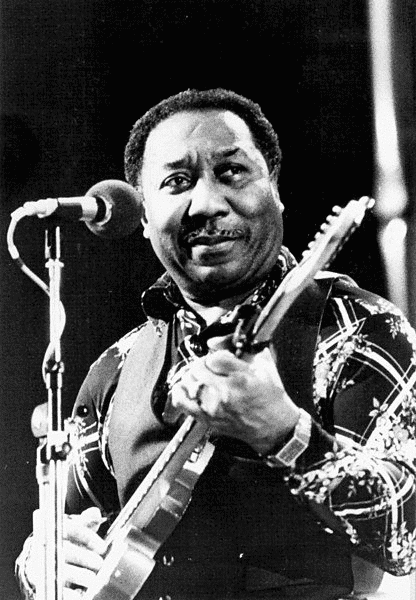
Artist Details
- ARTIST NAME: Muddy Waters
- ERA: Chicago Electric Blues (1945–1965)
- BIRTH / DEATH: Born McKinley Morganfield, April 4, 1913, Issaquena County, Mississippi — Died April 30, 1983, Westmont, Illinois
- GEOGRAPHIC ORIGIN: Mississippi Delta → Chicago’s South Side
- VOCAL TYPE: Baritone — powerful, commanding, authoritative
- PRIMARY INSTRUMENT: Electric slide guitar
- SECONDARY INSTRUMENTS: Harmonica (occasionally); National steel guitar (early career)
- SIGNATURE SOUND: Amplified Delta slide guitar over a driving rhythm section; deep, rolling baritone anchored by Little Walter’s harmonica and Jimmy Rogers’ second guitar. The Chess Records production gave it weight and sheen — the sound of the Delta arriving in the city and refusing to apologize for anything it brought with it.
- RECORD LABELS: Aristocrat Records; Chess Records
- COLLABORATORS: Little Walter (harmonica), Jimmy Rogers (guitar), Otis Spann (piano), Willie Dixon (bass and primary songwriter), James Cotton (harmonica)
- INFLUENCES ON: The Rolling Stones (named themselves after his 1950 recording), Eric Clapton, Jimi Hendrix, Buddy Guy, Johnny Winter, and virtually every Chicago-style blues guitarist of the post-1955 era
- INSTRUMENTATION TAGS: Electric guitar; slide guitar; amplified harmonica; bass; drums
- STYLE TAGS: Delta-rooted Chicago electric; amplified slide; South Side groove; Chess sound; urban electric
- MBS CONNECTION: Muddy Waters’ influence is felt in virtually every Chicago-style blues performance on the MBS stage. His blueprint — Delta roots, electrified and urbanized — defines what we celebrate at MBS showcases, and his recordings serve as essential curriculum in MBS educational programming.
KEY RECORDINGS:
- “I Can’t Be Satisfied” (1948, Aristocrat/Chess Records)
- “Rollin’ Stone” (1950, Chess Records)
- “Hoochie Coochie Man” (1954, Chess Records)
- “Mannish Boy” (1955, Chess Records)
- “Got My Mojo Working” (1956, Chess Records)
Key Takeaways
- Muddy Waters, born McKinley Morganfield, revolutionized Chicago electric blues, blending Delta roots with urban sound.
- He recorded influential tracks like ‘Hoochie Coochie Man’ and ‘Mannish Boy’ during his time with Chess Records.
- Muddy’s music inspired countless artists, including The Rolling Stones and Eric Clapton, establishing a global blues footprint.
- His legacy lives on through the Madison Blues Society, celebrating his impact on Chicago-style blues.
- Muddy Waters’ signature sound features amplified slide guitar and a deep, commanding baritone, defining the essence of blues.