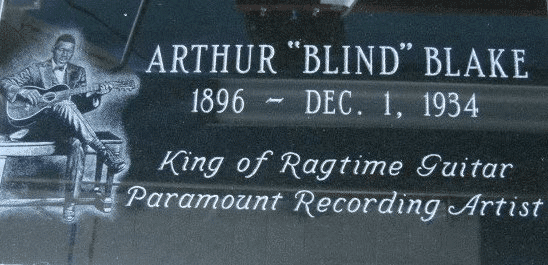
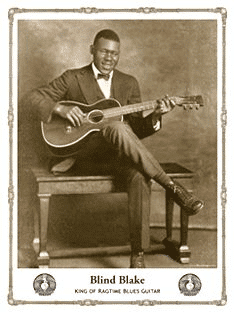
Arthur “Blind” Blake stands as one of the most dazzling, technically gifted, and enigmatic figures in early American blues. Born in 1896, most reliably documented as Newport News, Virginia, according to his rediscovered 1934 death certificate, Blake’s early life remains largely obscured by time. Paramount Records promotional materials once claimed he was born in Jacksonville, Florida, and Blake himself spent significant periods in Florida and Georgia, contributing to decades of confusion about his origins. What is clear is that Blake was blind from birth or early childhood, and like many visually impaired musicians of the era, he turned to music as both vocation and survival.
Childhood
Little is known about Blake’s childhood or musical training, but researchers believe he likely learned guitar informally from local musicians in Virginia, Florida, or Georgia. By his teens and early twenties, Blake was traveling widely across the Southeast, performing at fish fries, country suppers, medicine shows, street corners, and juke joints—the informal venues that incubated early blues and ragtime styles. His occasional use of Gullah dialect on recordings such as “Southern Rag” suggests cultural ties to the Georgia Sea Islands, though the specifics remain speculative.
Performance History
Blind Blake’s performance life stretched across the American South and Midwest, reflecting the mobility and improvisational spirit of early blues musicians. In his youth and early adulthood, Blake played throughout Georgia and Florida, performing at fish fries, country suppers, house parties, street corners, and juke joints—the informal community venues that shaped the earliest blues traditions. His occasional use of Gullah dialect on recordings such as “Southern Rag” strongly suggests time spent performing in the Georgia Sea Islands and Savannah region, where coastal cultural traditions influenced his rhythmic, ragtime‑infused guitar style.
Blake is also widely associated with medicine shows, the traveling vaudeville-style troupes that crisscrossed the Southeast during the 1910s and 1920s. These shows relied on charismatic musicians who could entertain crowds with humor, dance rhythms, and dazzling instrumental skill—qualities Blake possessed in abundance. Though specific troupes are not documented, his repertoire and stage patter align closely with musicians who worked these circuits.
Paramount Recordings
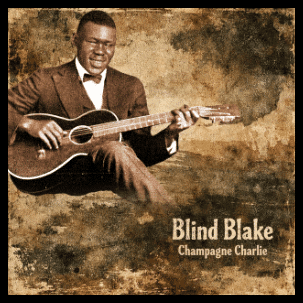
His professional breakthrough came after he reached Chicago, where Paramount Records recognized his extraordinary talent. Between 1926 and 1932, Blake recorded dozens of sides for Paramount while performing around the city’s South Side clubs, rent parties, taverns, and social gatherings. Chicago served as the hub of his recording career, and many blues scholars believe he played frequently in the neighborhoods surrounding Paramount’s studios.
Blake also spent significant time in Grafton, Wisconsin, where Paramount operated its later recording facilities. While Grafton was not a performance destination in the modern sense, Blake played informally around the studio—at boarding houses, taverns, and musician hangouts—as part of the lively community of artists who passed through the small-town during Paramount’s peak years.
In the early 1930s, after Paramount collapsed, Blake relocated to Milwaukee, Wisconsin, where he lived with his wife Beatrice. During this period, he performed locally in neighborhood taverns, social halls, and private gatherings, continuing to work as a musician even as the Depression made opportunities scarce. Milwaukee blues historians note that Blake was known in the community as a working guitarist until his death in 1934.
Across all these regions—Florida, Georgia, Chicago, Grafton, and Milwaukee—Blind Blake’s playing left a lasting imprint. Whether on bustling city streets or rural Southern gatherings, his music carried the same unmistakable blend of ragtime brilliance, rhythmic precision, and joyful invention that would earn him the enduring title “King of Ragtime Guitar.”
Recognition
Blake’s breakthrough came in the mid‑1920s when Paramount Records recognized his extraordinary talent. Between 1926 and 1932, he recorded approximately 80–84 sides, making him one of Paramount’s most prolific and commercially successful artists, rivaled only by Blind Lemon Jefferson. His recordings—cut in Chicago and later at Paramount’s Grafton, Wisconsin studio—reveal a musician of astonishing precision, speed, and rhythmic sophistication. Blake’s guitar style, often described as ragtime piano translated to six strings, featured intricate three‑finger picking, syncopated bass lines, and sparkling melodic runs that set a new technical benchmark for blues guitarists.
Signature Recordings
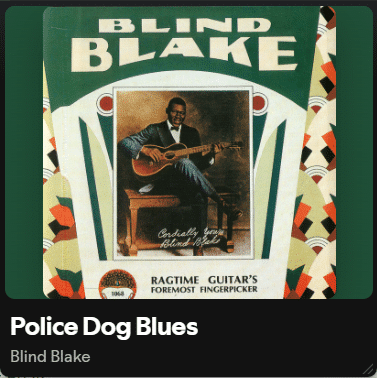
Signature recordings such as “West Coast Blues,” “Southern Rag,” “Early Morning Blues,” and “Police Dog Blues” showcase not only his virtuosity but also his humor, warmth, and storytelling flair. Blake was equally adept as a session musician, accompanying major blues figures including Ma Rainey, Ida Cox, Papa Charlie Jackson, and Gus Cannon during Paramount’s peak years.
Despite his musical success, Blake’s personal life remained modest and often precarious. He married a woman named Beatrice around 1931, and by the early 1930s the couple had relocated to Milwaukee, Wisconsin, part of the broader Great Migration of Black Southerners seeking work in northern cities. When Paramount collapsed during the Great Depression, Blake’s recording career abruptly ended. He continued performing locally but struggled financially and died in Milwaukee on December 1, 1934, reportedly from tuberculosis, at just 38 years old .
For decades, Blake’s grave was unmarked and his life shrouded in mystery until researchers rediscovered his burial site in 2011, renewing interest in his legacy. Today, Arthur “Blind” Blake is celebrated as the King of Ragtime Guitar, a foundational architect of Piedmont blues whose influence echoes through generations of acoustic guitarists.