Alberta Adams was an American blues vocalist who became a central figure in the Detroit music scene. Initially a tap dancer, she began singing in Detroit clubs during the 1940s. She later recorded for prominent labels like Chess Records and toured with major music legends.
After a recording hiatus, Adams launched a successful solo career in the late 1990s. She composed and released multiple acclaimed albums, continuing to record and perform into her nineties. Known as Detroit’s Queen of the Blues, Adams passed away in 2014 at age 97.
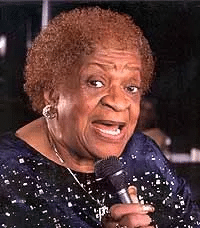
The Queen of the Blues, b. July 26, 1917 – December 25, 2014
There are artists who play the blues, and then there are artists who are the blues. Alberta Adams belonged firmly in the latter category. Born Roberta Louise Osborn on July 26, 1917, in Indianapolis, Indiana, and raised in the churning, electric blues capital of Detroit, Michigan, Adams spent nearly nine decades forging one of the most authentic and enduring careers in American music history. AllMusic called her “the personification of the Detroit blues scene,” and few titles have ever been more honestly earned.
From Hastings Street to the World Stage
Adams came up hard. Escaping a difficult home life at the age of fourteen, she struck out on her own — renting a small apartment near Woodward Avenue and navigating Detroit on her terms. It was a boldness that would define her entire life. She found her footing in Detroit’s legendary Hastings Street club circuit, initially as a tap dancer before her voice drew the rooms in a way her feet never could alone. The turning point came at the B&C Club in the 1940s, when headliner Kitty Stevenson fell ill and Adams stepped up for an impromptu two-song set. The audience responded so strongly that the club hired her as their featured vocalist for a five-year run. The woman who had gone to the club as a dancer left as a singer — and never looked back.
🎵🎵Discogs: Amanda Adams’ “Detroit is my home” 🎵🎵
Her schooling on Hastings Street was second to none. Her contemporaries and informal musical teachers included John Lee Hooker, Big Maceo Merriweather, Eddie “Guitar” Burns, and Eddie Kirkland — a murderers’ row of Detroit blues royalty. Adams absorbed it all, citing blues shouter Big Joe Turner and iconic singer-songwriters Dinah Washington, Sarah Vaughan, and LaVern Baker as the voices that shaped her own.
Chess Records and the Big Leagues
By the 1950s, Phil and Leonard Chess of Chess Records — the label that shaped the sound of American music — heard Adams performing on Hastings Street and signed her. She recorded with Red Saunders’s band for the label, and those sessions would later find renewed life on Chess compilation albums released in the 1990s. During this era she also recorded for Savoy Records in Newark, New Jersey, cutting the single “Say Baby Say” with the T.J. Fowler Band, and spent time as a member of The Bluesettes, a vocal group that toured with Tiny Bradshaw’s celebrated big band.
Her touring resume reads like a who’s-who of 20th century American music: Louis Jordan, T-Bone Walker, Duke Ellington, Eddie Vinson, and Lionel Hampton. She didn’t open for legends — she shared stages with them as a peer.
A Solo Renaissance
After a period away from heavy recording, Adams came roaring back in the 1990s through her association with guitarist Johnnie Bassett and manager/musician R.J. Spangler. Her contribution to the 1997 Blues Across America: The Detroit Scene compilation was the spark that re-ignited everything. AllMusic noted that the album “gave her career a boost” and led directly to a solo recording contract.
What followed was a remarkable late-career flourishing. Her debut solo album, Born with the Blues (Cannonball Records, 1999), recorded with Bassett and pianist Bill Heid, was composed largely by Adams herself and earned a spot on Living Blues magazine’s Top 25 Albums of 1999. AllMusic praised it warmly, writing that “Adams still has a sizable amount of honey in her voice… just solid singing by a true American music treasure.”
Her follow-up, Say Baby Say (2000), drew raves from MTV, which noted that “the main attraction here is the forcefully husky-voiced Adams,” highlighting her “candid attitude and masterful timing.” The album earned four out of five stars from AllMusic, which observed that Adams “looked back on a life raising three children and three stepchildren, four marriages, and decades of blues performance.”
In 2004, I’m on the Move (Eastlawn Records) arrived with an AllMusic rating of 4.5 out of 5 stars and a glowing assessment: the album “finds Adams at the top of her game and seeming to enjoy herself.” Two years later, her EP Detroit’s Queen of the Blues won Outstanding Blues/R&B Recording at the 2006 Detroit Music Awards — a fitting crown for a woman who had always been royalty.
Still Working at 91
Perhaps most astonishing is what Adams did at an age when most people are long retired. At 91 years old, she recorded Detroit Is My Home (2008, Eastlawn Records), featuring background vocals by CeeCee Collins and Thornetta Davis, and piano contributions from Ann Rabson. She continued contributing to albums through 2013, including Definitive Detroit Blues (Not Now Music). In February 2014, just months before her passing, fellow singers Thornetta Davis and Tosha Owens honored the then-96-year-old with a tribute concert titled “To Alberta with Love.”
Alberta Adams died on December 25, 2014, in Dearborn, Michigan, at the age of 97. In July 2016, her niece, singer Lily Delois Adams, performed a tribute concert in Detroit in her memory.
A Legacy Written in Tone
Mostly self-taught as a vocalist, Adams never needed a conservatory to develop one of the most distinctively powerful voices in blues history. She was a composer, a performer, a survivor, and above all, an original. As AllMusic declared without equivocation: “the undisputed, unrivaled, peerless Detroit Queen of the Blues is Alberta Adams.”
In a genre built on truth-telling, Alberta Adams told nothing but.